In a sense, Shakespeare’s Henry VIII is the final chapter in his centuries-long epic history of the period known today as the War of the Roses. Think the Godfather series is long, at a mere three movies spanning three generations? Shakespeare’s “English history plays” include Richard II, Henry IV (Parts 1 and 2), Henry V, Henry VI (Parts 1, 2 & 3!), and culminating with the legendary Richard III. That’s eight plays, covering the reigns of seven kings (King Edward IV reigns at the beginning of Richard III, his young son Edward V dies in the Tower, and Henry VII makes a brief appearance at the end.)
Most people stop counting after that, forgetting that our Bard also had a hand in the writing of Henry VIII, for a total of nine plays depicting events over some 130 years. (Godfather may reach that mark someday, but don’t expect me to watch.) In fact, if you count the appearance of Elizabeth I as a baby, we see nine monarchs over the course of nine plays. Now that’s epic.
Notice I wrote that Shakespeare “had a hand in the writing of Henry VIII,” not that he was “the writer”. That’s because, although the play was published under his name, it is most likely a collaboration with John Fletcher, the writer who replaced Shakespeare as the principal playwright of the King’s Men. (He also teamed up with Shakespeare on Two Noble Kinsmen.) The only evidence for this is circumstantial, but nonetheless convincing:
For one thing, the earliest known performance was in 1613, after Shakespeare’s presumed retirement in 1611. It’s not clear if the two men were in a true partnership, or if Fletcher was merely completing or revising an earlier (and unknown) work by the Bard. Nonetheless, it makes more sense to believe that a semi-retired Shakespeare would have agreed to write some scenes with London’s hot new talent than that he wrote the whole thing himself.
Also, several scenes are written in a style more typical of Fletcher than Shakespeare. For example, Fletcher used many more contractions than Shakespeare. And to be fair, Fletcher just wasn’t as good a writer.
Judge for yourself! As you read, ask yourself “Shakespeare? Or not Shakespeare?” Then check your answers against the historians’ consensus (below).
——————————————–
Probably Shakespeare:
Act I scene i, scene ii; Act II, scene iii, scene iv; Act III scene ii (to exit of king); Act V scene i
——————————————–
Probably not Shakespeare:
Act I, Prologue, scene iii, scene iv; Act II, scene i, scene ii; Act III scene i, scene ii (from exit of king to end); Act IV scene i, scene ii; Act V scene ii, scene iii, scene iv, scene v, Epilogue
——————————————–
Henry VIII was very much an accidental king of England. He was never supposed to reign, as he was merely the younger brother of the heir apparent Arthur. (That’s right — had that elder brother lived, he would have been King Arthur!) Arthur had already been married to the daughter of the Spanish king, in hopes of a political alliance, and Henry was just the little brother doomed to a life of standing in the shadows.
Then Arthur died, and Henry not only succeeded him, he took his place as the husband of his queen, Catherine of Aragon. This is really the central fact of the narrative, not only for the Shakespeare character, but for the historical Henry as well. When he failed to produce a male heir, Henry claimed that this was God’s punishment for having married his brother’s wife. Did he really believe that? or was it just a means unto an end? In any case, he insisted that the marriage was never legitimate, and when the Vatican refused to recognize the divorce and later marriage to Anne Boleyn, it led to the schism between the Churches of England and Rome that continues to this day.
His single-minded pursuit of a son also resulted in both his chancellor Thomas More and several of his subsequent wives being beheaded, including Anne Boleyn, but Shakespeare is careful to avoid this aspect of history in the play.
By the way, Henry VIII bears the subtitle “All is True”. This strikes me as a kind of “doth-protest-too-much” disclaimer. Why did they find it necessary to assure their audience that what they were about to see was a true story? My personal theory is that, unlike his other history plays describing events from a century earlier or more, this one depicts historical events for which it was possible for people then alive to have personal knowledge, either first- or second-hand. This play is not primarily a form of literature or entertainment, but rather propaganda for the Tudor dynasty. Probably intended partly as an obituary for Shakespeare’s patron Elizabeth and partly as payback for her patronage, the play must also whitewash the excesses of her father’s reign, despite the memories of those whose parents and grandparents would have remembered or even experienced that tyranny themselves.
It’s never stated what game Henry and Suffolk are playing in Act V, but traditionally Henry was reputed to be a fantastic tennis player.
I was surprised to find that there is debate about the date of the work: whether it first appeared before or after the death of Elizabeth in 1603. To me it’s obvious, since in the final scene the praise of the infant Elizabeth really goes over the top, which makes more sense when speaking of a dead person than one still around. Notice, also, how the Archbishop prophesies that the queen will die a virgin, leaving the audience to appreciate that, in retrospect, the prophesy came true. However, other scholars have written that some monarchs liked being praised while they were still alive, and Elizabeth was one of them.
——————————————–
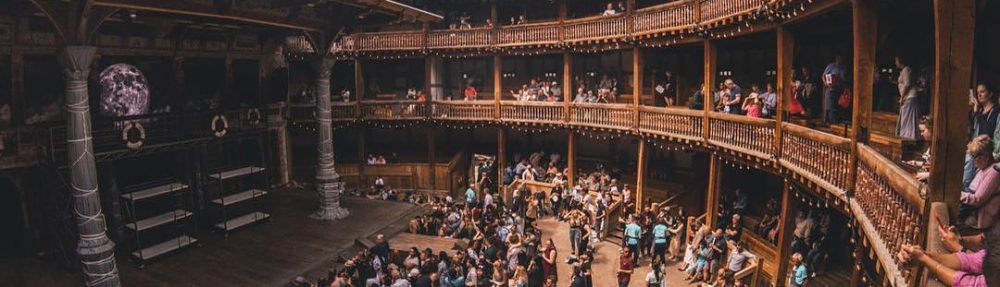
Unfortunately, for most people who know the play at all, it’s best known as the show being performed when the Globe Theatre burned down in 1613. (The cannon blast announcing the arrival of the king in Act I scene iv set the thatched roof on fire. What a shame this happened near the beginning of the play, making it impossible that “the show must go on.” All these years later, I have to wonder: did the customers get their money back?)
Synopsis
ACT I
PROLOGUE
A narrator warns the audience that the play they are about to watch will make them sad. (Perhaps a reminder of the [recent?] death of Queen Elizabeth.)
scene i
The scene opens with a very long, detailed, and historically accurate account of a meeting between Henry VIII and King Francis I of France. Partly intended to shore up diplomatic relations, it was also an ostentatious display of wealth and power on both sides, by two monarchs consumed by ego. It is known to history as the Field of the Cloth of Gold.
The Duke of Buckingham is arrested, along with several of his allies, for treason. It is strongly implied that the charges are political payback due to Buckingham’s rivalry with the ambitious Cardinal Wolsey.
scene ii
Queen Katherine (Shakespeare spells it with K) protests Wolsey’s abusive taxes; but Wolsey is King Henry’s favorite and he defends him. Katherine also complains about the arrest of Buckingham, but the King orders Buckingham’s trial to go forward.
scene iii
Amid the gossip of the court, we learn the news of a lavish banquet thrown by Wolsey.
scene iv
The King and his attendants, disguised as foreigners, crash the banquet. Does Wolsey really not recognize him? or is he just humoring him?
The King dances with Anne Boleyn, and immediately falls head over heels in love with her.
ACT II
scene i
Two anonymous Gentlemen describe Buckingham’s treason trial, interrupted by Buckingham himself, in custody, saying goodbye to his followers.
scene ii
Wolsey initiates the divorce action against the Queen. He does his best to appear impartial, including bringing in Campeius, a cardinal from Rome, to serve as her intercessor. In fact, Campeius is completely under Wolsey’s influence.
scene iii
Anne Boleyn tells her attendant how she feels sorry for the queen and would never want to be one herself. When the Lord Chamberlain announces that the King has suddenly elevated Anne to a high title, the Marchioness of Pembroke, the Old Lady jokes about how suddenly Anne’s fortunes have turned.
scene iv
Katherine’s trial begins, but she refuses even to stay and listen. The King tries to continue in her absence, describing how he doubted the legitimacy of their marriage. Only when Campeius protests that the hearing cannot continue does the King reluctantly adjourn the proceeding.
ACT III
scene i
Later, while relaxing with her ladies-in-waiting, Katherine complains to Wolsey and Campeius about her treatment.
scene ii
In a very long scene, the nobles working against Wolsey get a lucky break: by mistake, he included some incriminating evidence in a packet of letters to the King, along with a list of his many properties, showing how he’s gotten immensely rich while in office. Wolsey realizes he has lost the game, so he separates himself from his assistant Cromwell. It’s a very generous move on his part; even though Wolsey’s fall from grace is a sure thing, this way Cromwell can continue his career at court.
ACT IV
scene i
The same two anonymous Gentlemen from Act Two return, to observe and comment upon the lavish procession for Anne Boleyn’s coronation as Queen, with very specific details taken directly from the historical record.
scene ii
Katherine never recovered her health after the divorce, but is shown being magnanimous toward Anne, her replacement.
ACT V
scene i
The king plays tennis, but can’t concentrate on the game due to nervousness about Anne Boleyn going into labor. He meets with Cranmer, the new Archbishop of Canterbury, and assures him of full royal support. Anne gives birth to a daughter.
scene ii
A faction of nobles plots against Cranmer. In a stunning snub, they force him to wait in the lobby for an audience with the king, as if he were not the most powerful clergyman in England. The king’s personal physician observes this, and brings it to the king’s attention.
scene iii
The King expresses his full support for the Archbishop in front of the very nobles who snubbed him.
scene iv
Porter and his Man have to deal with the uncontrollable crowds arriving to witness the christening of young Elizabeth.
scene v
The Archbishop makes a startlingly specific prophesy about the baby princess and her future reign. (Like all characters in Shakespeare who make prophecies, his are 100% accurate.)
EPILOGUE
The play’s narrator returns to tie up loose ends.
 Shakespeare-sama, Tokyo