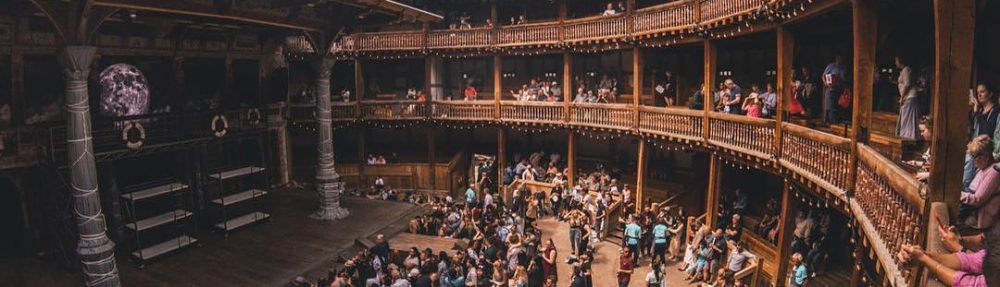
Love’s Labour’s Lost is one of the many Shakespeare plays that don’t fit easily into a category, such as tragedy or comedy. Over the years, scholars have devised a third description for such works as Troilus and Cressida that have jokes but also end on a sad note: they call them “problem plays” (although I prefer the term “romances”.) LLL shares another characteristic with Troilus: a lot of the humor relies on sophisticated wordplay, pedantic humor and dated literary allusions, compared with Shakespeare’s more popular works. It’s clearly trying to be funny, but the humor of this play is aimed at a very specific audience: namely, Queen Elizabeth. I find it useful to think of LLL, rather than either comedy or tragedy, instead as a medieval pageant: the European custom of performing skits related to a special occasion, usually a religious holiday. In this case, it is believed to have been written for a performance at the Inns of Court before the queen, perhaps in 1595. It would have guaranteed that the only people in attendance would be very urbane and culturally hip, certain to understand all the topical references to historical personages and political situations upon which the humor depends.
Love’s Labour’s Lost is, like The Tempest and Midsummer, a play without any obvious sources. The four main male characters are all loosely based on historical figures; Navarre is based on Henry of Navarre (who later became King Henry IV of France); Berowne on Charles de Gontaut, the duke of Biron; Longaville on Henri I d’Orléans, the duke of Longueville; and Dumain on Charles, the duke of Mayenne (duc de Mayenne). In 1578 Henry’s estranged wife, Marguerite de Valois, paid him a visit to discuss the disposition of the Aquitaine region. Of course, she was in the company of her ladies-in-waiting.
Although it was included by Francis Meres in Palladis Tamia (an Elizabethan version of the old Who’s Who series, published in 1598) as one of Shakespeare’s plays, there is little concrete evidence with which to date it. It was probably first performed c.1594-1595. The play was revised, according to the cover of the first surviving quarto, also published in 1598. The title-page also states that the play was ‘presented before her Highness this last Christmas’. With some variations, the play was also published in the First Folio (1623), a posthumous collection organized by his friends.
The plot follows the King of Navarre and his three companions promising each other they will focus for three years on their studies to the exclusion of all distractions — especially women, going so far as to ban romance throughout the entire kingdom. Their determination lasts right up until they meet the beautiful Princess of France and her ladies-in-waiting. Naturally, each man falls in love with one of the ladies, who conveniently each fall in love with that same man. Caught between their vows to study and the dictates of the heart, the men must attempt to simultaneously feign outrage at their colleagues’ flirtations while hiding their own. The ladies, however, can’t stop laughing at the transparent ruses. Finally, all pretense is dropped, and they court each other openly. Many Shakespearean complications ensue, including the “play within a play”; not one, but two (counting the scene where the nobles pretend to be Russians). A stock character from classical theater, that of a swaggering braggart, appears in the person of Don Armado, an easily mockable foreigner; he also tests, and exceeds, the limits of the king’s ban on dating. In the end, a messenger arrives announcing the death of the Princess’s father, meaning she is now queen, and must return to France. In that period of mourning, all the lovers promise to be true to their vows, and to renew their courtship in a year.
One must resist the urge, in reading our Bard, to pronounce French names the French way. Whether or not Shakespeare could speak French (which some scholars continue to doubt) he was an Englishman writing for a London audience, and his tendency was to use even foreign words with a decidedly British accent. Hence Agincourt is pronounced “AJ-in-COURT”, and the name Jaques is pronounced “JAY-kweez”. Likewise, it is clear that the character Boyet’s name is not pronounced with a silent T, especially since Berowne very distinctly rhymes the name with “debt”.
In that same speech, Berowne praises Boyet as “honey-tongued” — coincidentally, the same epithet which Francis Meres had used in the aforementioned Palladis Tamia to describe Shakespeare himself. He included Love’s Labour’s Lost as an example of Shakespeare’s greatest works, so it’s just possible that Meres deliberately borrowed that phrase to compliment the poet with his own words.
The entertainment in Act Five, “The Pageant of the Nine Worthies”, represents nine conquerors from both legend and historical antiquity. They are traditionally identified as Three Pagans, Three Jews, and Three Christians:
- Hector – the greatest warrior for Troy in Greek mythology and Homer’s Iliad, who dies in battle with Achilles. He appears as a character in his own right in Troilus and Cressida.
- Alexander – (356 BC – 323 BC), commonly known as Alexander the Great, widely considered one of history’s most successful military commanders. His emblem was a lion.
- Julius Caesar – (100 BC – 44 BC) Roman general and statesman who turned the Roman Republic into an empire. Of course, he is the title character in his own Shakespeare play.
- Judas Maccabeus – Jewish general who freed Jerusalem from Greek domination (164 BC). The Jewish holiday of Hanukkah commemorates this victory. As the characters stress, he is not Judas Iscariot, who betrayed Jesus to the Romans with a kiss, then in his remorse hanged himself from a tree.
- Joshua – led the Israelite tribes in the conquest of Canaan after the death of Moses.
- King David – as a young shepherd he gained renown by killing the enemy champion Goliath; later established the kingdom of Israel.
- King Arthur – legendary British leader who … come on, I don’t have to explain King Arthur, do I? The guy who pulled the sword out of the stone?
- Charlemagne, or Charles the Great – (748 – 814) during the Early Middle Ages united Europe into what became the Holy Roman Empire.
- Godfrey of Bouillon – (1060 – 1100) one of the leaders of the First Crusade.
Due to the heckling from the four noblemen, the actors only get as far as Hector, Alexander, and Judas Maccabeus before everything comes to a crashing halt with the news of the French King’s death. However, Shakespeare alternated two other “Worthies”. The first is Hercules, famous in classical mythology for feats of strength. The other is Pompey, whom Costard calls “Pompion”, (106 BC – 48 BC), known in English as Pompey the Great, the main opponent of Julius Caesar, although he doesn’t appear as a character in the play of that name. He does share a name with another Shakespeare character, though: the comic pimp from Measure for Measure. Other characters in that play delight in making jokes, at his expense, about how the original Pompey was vanquished by Caesar.
There may have been a special significance to the princess killing a deer in the park: according to lore, as a young man William Shakespeare of Stratford was believed to have been caught and punished for poaching deer from a wealthy man in Stratford. Was our Bard recalling this embarrassing incident from his youth? Was he merely mocking the rumor? (N.B. As with much of the biographical information we have of our Bard, the evidence is sparse, so don’t read too much into this. I mention it only as a tantalizing possibility.)
The reference to “Blackamoors” in Act V is just as bad as it sounds: it is a derogatory term for Africans used as servants, and they were undoubtedly played by white actors in blackface.
The monologue by Berowne at 4.3.284–361 is possibly the longest speech in all of Shakespeare’s plays, at 77 lines and 588 words. Certain passages within the speech seem to be redundant, so maybe these passages represent a first draft which was not adequately corrected before going to print.
Another record is in the length of Act Five. Most Shakespeare plays have a very short final act, but here, Act Five takes up over 900 lines, or approximately one third of the total running time. Oddly it also has a very short Act Three: only 205 lines, which is not much more than that very long speech by Berowne in Act Four!
Synopsis
Act 1
scene 1
Ferdinand, King of Navarre, and his three noble companions, the Lords Berowne, Dumaine, and Longaville, take an oath together resolving to forgo the company of women for three years to commit to a life of study and self-improvement. To help them keep their oath, the King demands that all women must remain at least a mile from the court. Additionally, this decree against women applies to the entire kingdom. When the local peasant Costard is caught pursuing his betrothed, Jacquenetta, he is arrested. After joking about Costard’s ignorance, the King puts him into the custody of Don Adriano de Armado, a flamboyant visitor from Spain.
scene 2
After sparring verbally with his servant Moth, Don Armado imprisons Costard as punishment for courting Jacquenetta. However, he admits having fallen in love with Jaquenetta himself, and decides to write her a letter, which is just as much against the King’s rules as what he arrested Costard for.
Act 2
scene 1
Soon after the oath, the Princess of France and her three ladies in waiting arrive on an embassy, wishing to speak to the King regarding the cession of Aquitaine. Due to the new laws put in place through the King’s pledge, the women are lodged a mile from the court. Nevertheless, they are granted an audience with Navarre and his friends, and the King falls in love with the Princess, as do the lords with the ladies (Berowne with Rosaline, Dumaine with Katharine, Longaville with Maria.)
Act 3
scene 1
In a very tacky move, Don Armado asks Costard to deliver the love letter he wrote to Jaquenetta. At the same time, Berowne writes a love letter to the lady Rosaline, giving it to Costard to deliver.
Act 4
scene 1
The princess, out hunting in the park, kills a deer. Costard finds Rosaline with her and gives her one of his two letters. Of course, by mistake he gives her Don Armado’s letter that was meant for Jaquenetta. The ladies have a good laugh reading it.
scene 2
Costard continues the confusion over the letters and gives Berowne’s letter to Jaquenetta. However, Jaquenetta can’t read, so she consults two scholars, the schoolmaster Holofernes and the parson Nathaniel, who conclude that the letter is written by Berowne. They recognize that Berowne’s letter is in violation of the King’s order and instruct her to tell the King about it.
scene 3
One by one, the King and his friends watch each other in hiding as they separately reveal having written letters that declare their love for the Princess and her ladies. At first Berowne can pretend that he is angry that his friends have broken their oaths, but then Jaquenetta and Costard enter with Berowne’s letter. After the truth is revealed, the men persuade each other that love is a legitimate form of study, so they collectively decide to relinquish the vow. First, however, they take turns criticizing the beauty of each other’s lady, and defending that of their own.
Act 5
scene 1
Nathaniel and Holofernes crack very abstruse jokes, involving classical allusions and multiple languages. Don Armado arrives with news of a party between the royals. Armado’s pageboy, Moth, shows himself to be quite clever himself. They make plans to entertain the royals with a pageant (along the lines of ‘Pyramus and Thisbe’).
scene 2
Possibly the longest scene in all of Shakespeare!
(a) The ladies have fun comparing their suitors and how they have been courted.
(b) The men arrive disguised as Russians to try to prank the ladies, but their servant Boyet overheard their planning, and instead the ladies trick the men by swapping clothes and impersonating each other. When the lords return as themselves, the ladies taunt them and expose their ruse.
(c) Impressed by the ladies’ wit, the men apologize for the trick. They sit and watch Holofernes, Nathaniel, Costard, Moth and Don Armado present a show called “The Nine Worthies” about some of the famous men from history, but only get through five of them. The four lords and Boyet heckle the play, and Costard reveals mid-pageant that Don Armado has made Jaquenetta pregnant.
(d) Their spat is interrupted by news that the Princess’s father has died, and she must leave to ascend the throne. Because of this news, the Princess declares a year-long period of absence between the men of Navarre and the women of France. The King and his men swear to remain faithful to their ladies. If, at the end of that time, their promises hold true, then the ladies may return to accept them in marriage. Don Armado announces he will swear a similar oath to Jaquenetta and then presents the nobles with a song.
 Shakespeare-sama, Tokyo