Hamlet is perhaps the best known and most recognizable of Shakespeare’s many well-known and recognizable works. Who could fail to identify the solitary figure standing holding a dagger to his own heart, or regarding the skull of the long-dead jester Yorick? Who, indeed, has never launched into the famous speech “To be, or not to be…”?
These three examples give only a taste of what may be the main theme of this multi-faceted play: a person faced with his own mortality and the temporary nature of human existence. At the time of its writing Shakespeare was approaching middle-age but still at the height of his creative powers. Even for an Englishman living in plague-ridden London, he was certainly no more likely than anyone else to die unexpectedly. However, he would have had ample reason to contemplate the death of a loved one, since his only son had died just a few years earlier, less than twelve years old.
That son’s name was “Hamnet”. Many have speculated on the similarity of the two names, but it was most likely just a tragic coincidence.
The story is not original: an earlier version, believed to be written by Thomas Kyd around 1589, was no doubt well-known to Shakespeare, but the source was an actual Danish/Icelandic saga about a Prince “Amlotha”. However, Shakespeare’s contribution was the conflicted character of Hamlet himself.
It is the story of a melancholy man having to accept the death of his beloved father and then finding out that his uncle is the murderer. He must reconcile his anger at his mother for her incestuous love for her late husband’s brother with his own suppressed Oedipal desires. He is a prince and a scholar who pretends to be crazy and sends two false friends to their death in order to get revenge for his father’s murder, along the way sacrificing his family, his girlfriend and ultimately his kingdom and his own life. Hamlet is the role that all Shakespearean actors dream of playing. Many have also performed the role for the silver screen, including Laurence Olivier (1948), Derek Jacobi (BBCTV, 1980), Mel Gibson (1990), Kenneth Branagh (1996) and most recently Ethan Hawke (2000).
The false friends Rosencrantz and Guildenstern have been immortalized in their own play, Tom Stoppard’s “Rosencrantz and Guildenstern Are Dead”, which tells the story of Hamlet from their point of view.
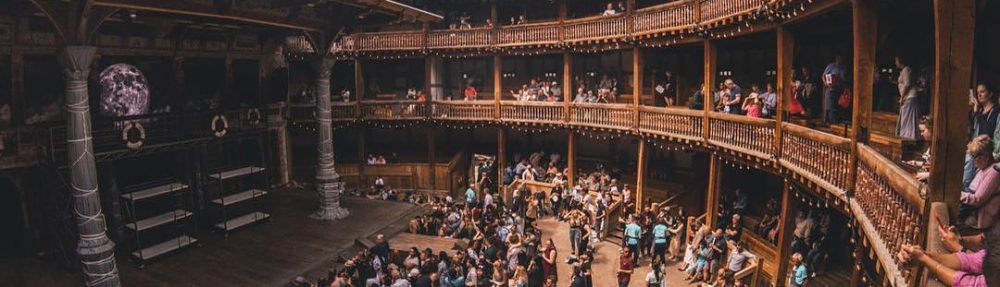
When the Players arrive and talk to Hamlet, we are privileged to see how theater companies of Shakespeare’s day must have operated. When Hamlet jokes with the “young lady and mistress” (actually a teenaged boy) that he has grown taller and soon his voice will change (Act 2 scene 2), it was no doubt a real and all-too-common danger for acting companies in a day when women were not allowed on the stage at all. There is a mention of a theater company in which the actors are all children — in fact, that was a fad during Shakespeare’s life. Hamlet’s Instructions to the Players (Act 3 scene 2) is almost certainly the heartfelt opinions of the Bard himself. How many times must he have cringed as he heard his beautiful lines being butchered by bad acting?
There is an interesting parallel between Fortinbras and Hamlet. When Fortinbras’ father was killed (by Hamlet’s father) he was succeeded as king by Fortinbras’ uncle. However, there is no mention that this uncle also married Fortinbras’ mother!
Traditionally, Polonius is portrayed as a windbag and a hypocrite. This has always puzzled me, since for the most part the character is written as well-intentioned, if not especially lucky or clever. His goodbye speech to his son is often played as an example of his hypocrisy, since he offers countless ways in which Laertes must moderate his behavior, and then follows up with the grand conclusion: “To thine own self be true.” Again, I think it is unfair to play it this way, since each individual part of the speech prior to that is exceptionally good advice, especially “Neither a borrower nor a lender be.”
On a related note, many people believe that the poems and plays attributed to William Shakespeare were actually written by Edward de Vere, the Earl of Oxford. One piece of “proof” they offer is that the story of Hamlet bears many similarities to events in Edward’s life, and that the character of Polonius was based on a pompous nobleman named Lord Burghley, whose nickname may (or may not) have been “Polus.” Personally, I find this theory unconvincing. For more information on this controversy, you can consult http://shakespeareauthorship.com/polus.html and http://www.shakespeareauthorship.com/
There’s a lot of new vocabulary for this play!
arras – curtain
avouch – proof
bark – boat
calumny – malicious lies
caviar to the general – something too good to be wasted on the general public
(on which )chameleons live – empty air. It was believed (wrongly of course) that chameleons don’t need food, and get all their nutrition from the air.
cicatrice – scar
coted – passed (on the road)
dout – extinguish
e’il – evil
fardel – burden
fay – faith
God-a-mercy – “God have mercy”
haply – perhaps
moiety – half
murther – murder
Nemean lion – mythical lion whose skin was so tough no arrow or sword could kill it. Hercules was forced to strangle it with his bare hands.
orisons – prayers
porpentine – porcupine
sith – since
traduce – criticize, speak harshly about
vouchsafe – promise
warrant – promise
wont to – inclined to, accustomed to
ACT ONE
scene 1
Horatio witnesses the ghost of the dead king walking in the castle one night. He decides to tell his friend, Prince Hamlet. We learn that Denmark is at war with Norway, led by the young Prince Fortinbras.
scene 2
Young Hamlet is brooding over his father’s death two months earlier, and how quickly his mother got married to his uncle, Claudius, the new king. Laertes, son of the king’s chief advisor, Polonius, makes plans to return to his studies in Paris. Horatio tells Hamlet of seeing the ghost of his father, and they make plans to see it again that night.
scene 3
Polonius bids Laertes goodbye with many words of counsel. They both tell Ophelia, Laertes’ sister, not to allow Hamlet to woo her.
scene 4
Hamlet and Horatio see the ghost again. Hamlet decides to follow it, against the advice of Horatio.
scene 5
The ghost tells Hamlet that he was murdered by Claudius, who poured poison in his ear while he was sleeping. Worst of all, since he didn’t have a chance to pray, he died with all of his sins on his soul, and so must spend some time in purgatory before he can go to heaven. Hamlet swears to avenge his death, and will pretend to be insane in order to throw Claudius off-guard. Horatio swears to keep the secret.
ACT TWO
scene 1
Polonius sends Reynaldo to spy on Laertes. Ophelia reports that Hamlet is acting crazy.
scene 2
The king and queen ask Hamlet’s schoolfriends Rosencrantz and Guildenstern to spy on him and find out why he’s acting so strangely. Polonius, however, tells the king that Hamlet is distraught because Ophelia is rejecting his romantic advances. Two ambassadors report that Prince Fortinbras is giving up his war against Denmark, but asks for free passage through Denmark’s territory so that he can wage war against Poland. Hamlet pretends to be mad with Polonius. Rosencrantz and Guildenstern talk to Hamlet, but he suspects immediately that the King and Queen put them up to it. Hamlet is happy to hear that a troupe of traveling players has arrived in the castle. He instructs them to perform a play that will remind Claudius of the murder he committed.
ACT THREE
scene 1
Hamlet gives his famous speech in which he considers how much easier it would be to just commit suicide, but realizes that it is the fear that life on the other side is even worse that keeps many people from killing themselves. While Claudius and Polonius hide and overhear, Hamlet tells Ophelia to give up on the idea of marriage. She is distraught that Hamlet is acting in such a bizarre way.
scene 2
Hamlet gives his famous Instructions to the Players. They perform a play which mimics the murder of Hamlet’s father. Claudius gets very upset and leaves in a hurry.
scene 3
Claudius gives orders for Hamlet to be sent to England. Overcome with guilt over his deeds, he kneels down to pray. Hamlet sees him and is going to take the chance to kill him, then changes his mind. If he’s killed while he’s praying, he’ll go to heaven; Hamlet prefers to wait until he’s doing something evil, so he will go to hell. Ironically, Claudius stands up after Hamlet leaves, and admits that he was unable to pray.
scene 4
Polonius hides in the queen’s room while she criticizes Hamlet for his actions. He discovers Polonius behind the curtain, thinking he’s the king, and stabs him. He yells at his mother for marrying Claudius. The ghost of his father appears to remind him of his promise of revenge. Hamlet tells his mother he’s only pretending to be crazy, and makes her promise not to make love to Claudius again.
ACT FOUR
scene 1
Claudius calls for the body of Polonius to be found. His main fear is for his own safety, and preventing people from including him in their gossip.
scene 2
Rosencrantz and Guildenstern find Hamlet, but he runs away without telling them where he hid the body.
scene 3
They catch Hamlet, and Claudius sends him to England. Secretly, Claudius has arranged for Hamlet to be executed when he gets there.
scene 4
During his exile Hamlet sees Fortinbras leading his army against Poland, and feels guilty that he hasn’t acted on his goal to avenge his father’s death.
scene 5
Ophelia has gone mad over the death of her father, and Laertes is bent on revenge, but Claudius calms him down.
scene 6
Horatio receives letters from Hamlet; he’s been captured by pirates, but they return him to Denmark for ransom.
scene 7
Claudius and Laertes learn that Hamlet is returning to court. Claudius convinces Laertes that he can get his revenge by killing Hamlet. They conspire to have a fencing contest, in which Hamlet will have a little “accident”. In a huge fit of over-planning, they arrange first for one of the swords to be “unbated” (in other words, sharp); Laertes then resolves to coat his sword with poison; and then for LITERAL overkill, Claudius will have a pitcher of poisoned wine on standby. They are interrupted with the news that Ophelia is dead, drowned in the river.
ACT FIVE
scene 1
The famous graveyard scene. Two gravediggers remark upon their job, and Hamlet remarks on them behind their backs. When they find the skull of a jester from Hamlet’s youth, he launches into yet another soliloquy.
During Ophelia’s funeral Hamlet and Laertes try to outdo each other in their grief, and almost come to blows.
scene 2
Hamlet explains to Horatio that his false friends Rosencrantz and Guildenstern bore letters from Claudius ordering that Hamlet be killed upon arriving in England; he forged new letters instructing that Rosencrantz and Guildenstern be killed instead. Although Hamlet apologizes to Laertes, he insists upon the dueling match, and stabs Hamlet with his sharp and poisoned blade. However Hamlet takes his sword and stabs first him, then Claudius, and his mother accidentally drinks the poisoned wine. Arriving at this opportune time, Fortinbras takes control of the country as the curtains close.
 Shakespeare-sama, Tokyo